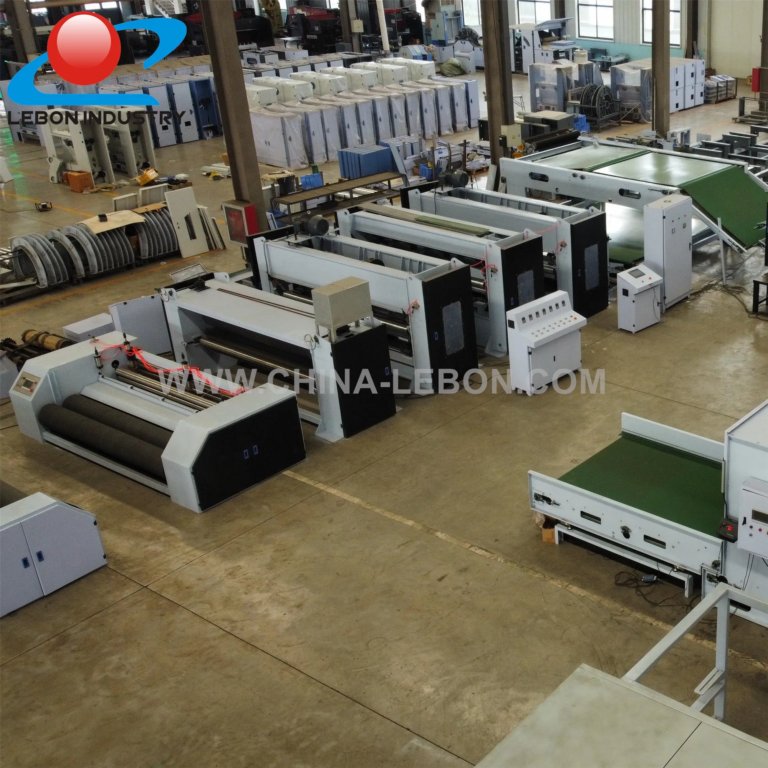
A geotextile production line is a fully integrated manufacturing system designed to produce nonwoven geotextiles — one of the most widely used geosynthetic materials in modern civil engineering. Geotextiles serve critical functions such as filtration, separation, drainage, reinforcement, and protection, and are extensively applied in water conservancy projects, airport construction, embankment engineering, and environmental protection initiatives.
This guide provides a comprehensive walkthrough of the geotextile manufacturing process, detailing each machine in the production line and its role in transforming raw synthetic fibers into high-performance finished rolls.
Production Line Process Flow
The standard geotextile production line consists of eight major stages, each building on the previous one to convert baled fibers into finished, rolled geotextile fabric:
Bale Opener → Fiber Opening Machine → Mixing Blender → Feeder → Carding Machine → Cross Lapper → Needle Punching Machine → Winding & Cutting Machine
Machine-by-Machine Breakdown
Each unit in the geotextile production line is engineered for a specific function. Below is a detailed description of every machine and its technical highlights.
1. Bale Opener
The bale opener is the first machine in the production line, responsible for opening cotton bales and performing quantitative, uniform feeding of fibers. When multiple units are combined, they enable proportional mixing of different fiber types with a wide automatic control range, ensuring accurate and consistent fiber blending ratios for diverse material formulations.
- Uniform, weight-based feeding for consistent downstream supply.
- Multi-unit configurations allow precise blending of multiple fiber types.
- Wide automatic adjustment range accommodates various fiber ratios.
2. Fiber Opening Machine
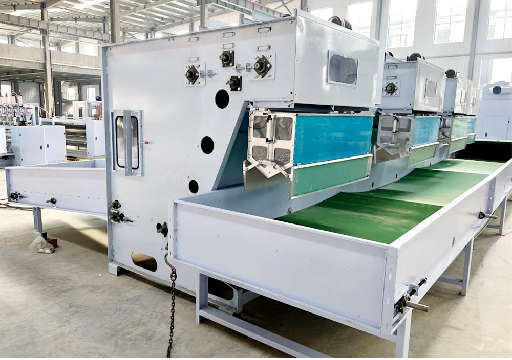
The fiber opening machine loosens and opens various types of baled fibers, then transfers them to downstream equipment via a fan system. It is designed to maximize opening efficiency while minimizing fiber damage.
- Pre-opening stage: Equipped with blade-type opening rollers to minimize fiber damage during initial processing.
- Main opening stage: Uses carding-pin pin rollers (comb-style) for high-efficiency, high-quality fiber opening.
- Metal impurity removal: Built-in strong magnetic separators capture metallic contaminants, protecting downstream machinery.
- Robust frame: Constructed from 8 mm thick welded steel plate, stress-relieved to eliminate welding residual stress and ensure long-term structural stability.
- Feed rollers: Available in two configurations — carding-cloth type and grooved type — to suit different fiber characteristics.
3. Mixing Blender
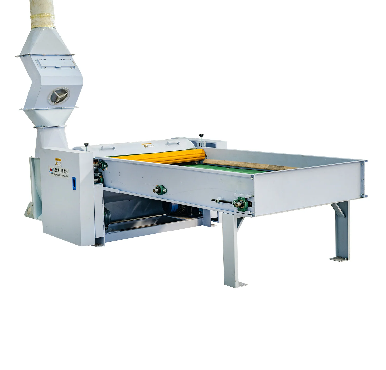
The mixing blender provides thorough blending and storage of fibers that have undergone preliminary opening, enabling continuous, uninterrupted production. Multiple fiber types are mixed and pre-opened simultaneously while metal and other impurities are removed.
- Achieves homogeneous fiber blending for consistent end-product quality.
- Storage capacity supports continuous production flow without interruption.
- Integrated metal and impurity removal for downstream equipment protection.

4. Feeder
The feeder further blends opened fibers and delivers a uniform, consistent fiber layer to the next process stage. It employs photoelectric quantitative control combined with a vibrating plate mechanism to ensure accurate, timely material supply.
- Photoelectric + vibration control: Guarantees even and precise fiber feed rates for consistent downstream supply.
- Two frame lengths: Available in 1400 mm and 1900 mm configurations; the 1900 mm model operates at reduced frequency, lowering startup wear and energy consumption.
5. Carding Machine
The carding machine is the heart of the web-forming process. It uses upper-feed cotton input to avoid fiber damage while ensuring uniform feed. Multiple safety and quality features protect both the machine and the consistency of the fiber web.
- Safety detection systems: Metal object detection, hard foreign object detection, and automatic thick-layer shutdown protect the machine from damage.
- Upper-feed design: Minimizes fiber damage while maintaining uniform feed consistency.
- Suction system: Removes fly, lint, and seed-leaf debris from the machine, preventing blockages, reducing cleaning frequency, lowering labor intensity, and ensuring a stable, even fiber web.
- Fully enclosed safety housing: Clean, orderly, and aesthetic exterior with comprehensive operator protection.
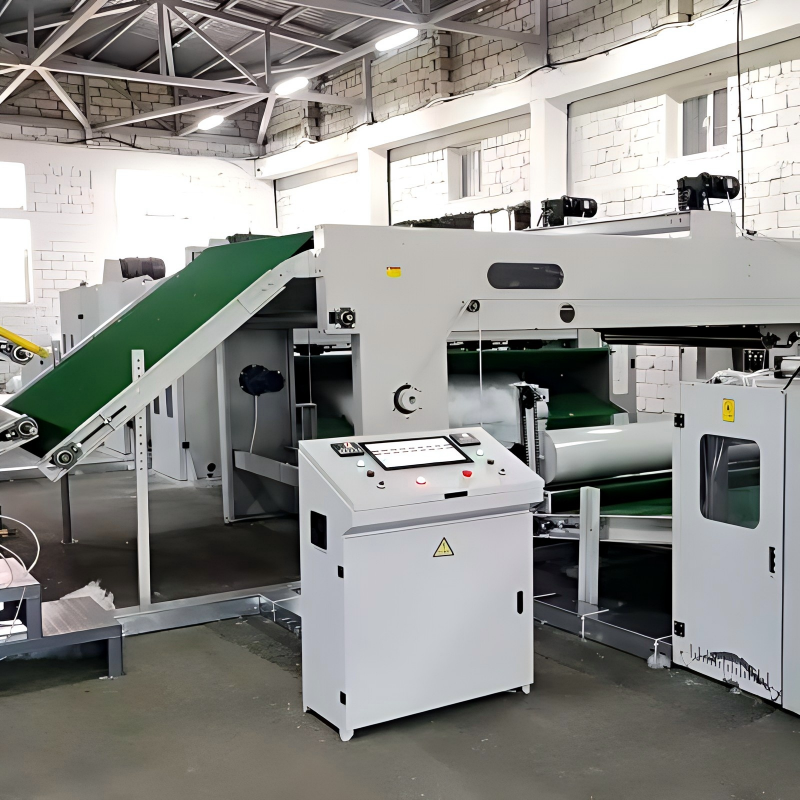
6. Cross Lapper
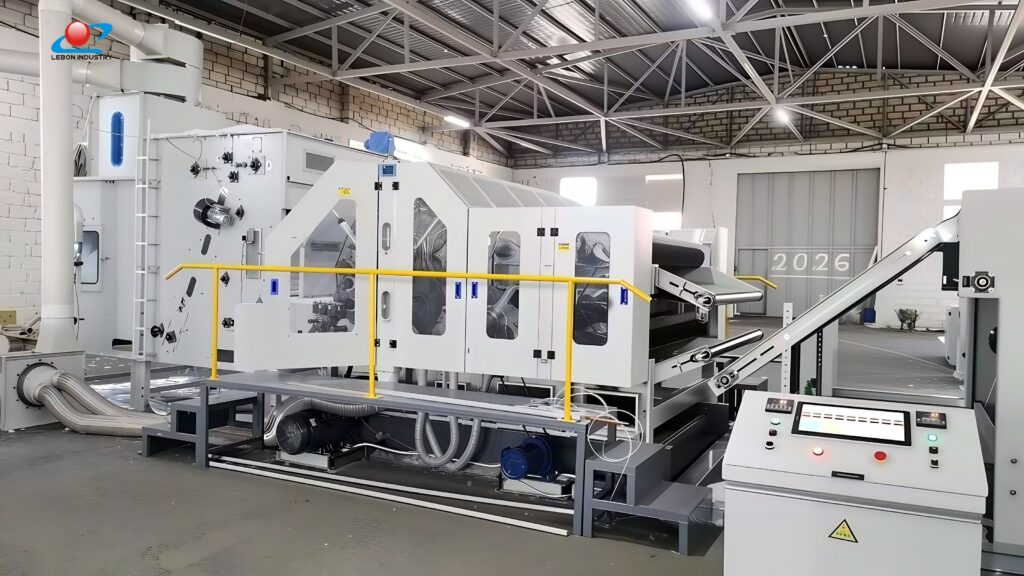
The cross lapper uniformly folds and layers the carded fiber web to the required width and thickness, compresses it, and conveys it to the next processing stage. Advanced control systems replace traditional photoelectric methods for superior precision.
- Independent drive curtains: Each laying curtain is individually driven for easy, independent adjustment.
- Variable-frequency reciprocating control: Smooth direction reversal; tracks feature anti-leak design.
- Robust frame: Built from 8 mm steel plate with bolted assembly for a clean, rigid structure.
- Computer-controlled 4–12 speed segments: Replaces traditional photoelectric control for enhanced accuracy.
- Dual lifting modes: Wire-rope mechanism supports both mechanical and manual height adjustment for operational convenience.
- Input curtain options: Available in wood-surface or leather-surface types.
7. Needle Punching Machine
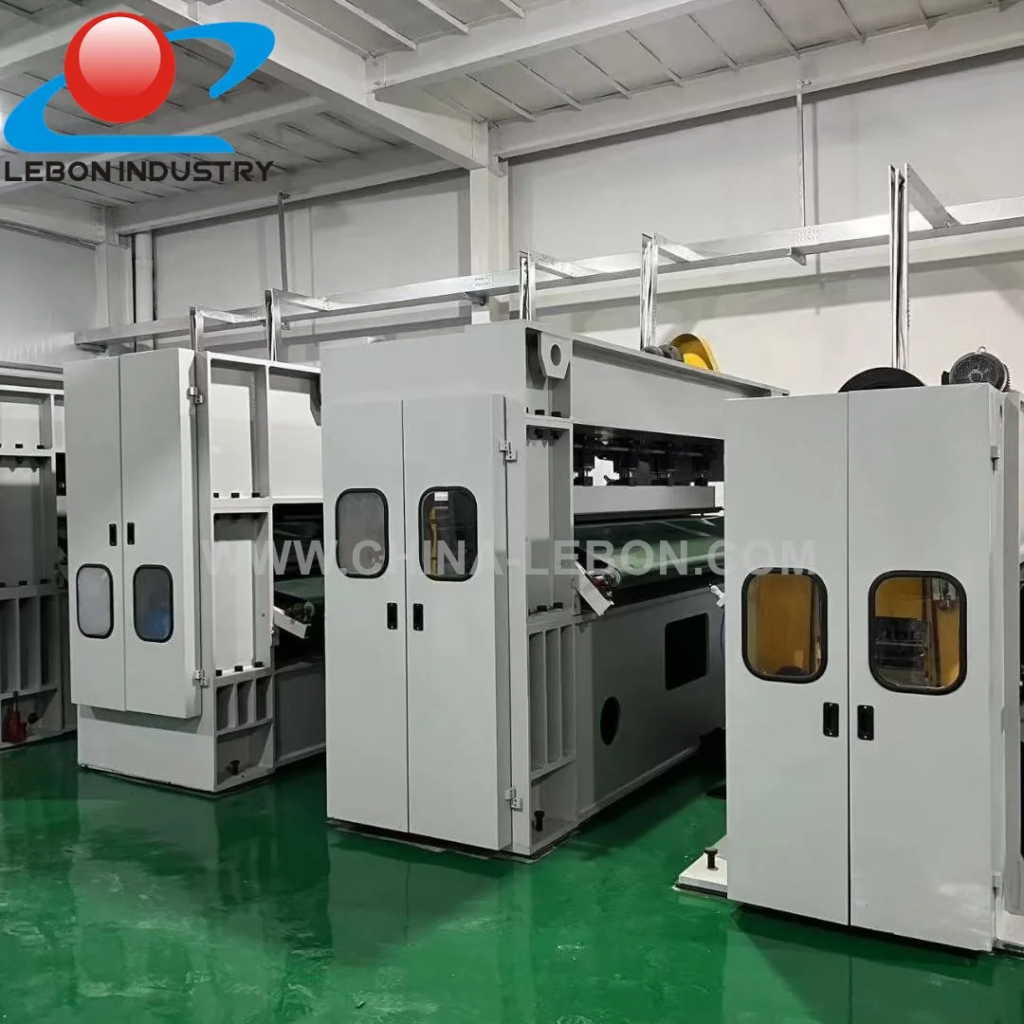
The needle punching machine is the core reinforcement equipment in nonwoven geotextile production. It uses barbed needles to mechanically entangle fibers, transforming the loose web into a strong, cohesive fabric. Needle-punched nonwovens offer excellent permeability and superior mechanical performance.
The needle punching section is typically divided into three stages: pre-needling, main counter-needling, and main needling, each progressively increasing fabric density and strength. The machine is also versatile — beyond geotextiles, it is used to produce needle-punched cotton, shoe materials, carpet backing, papermaking felts, and garment interlinings.
- Industry-leading parameters: Needle frequency, needle density, and needle arrangement patterns rank among the best in comparable domestic products.
- Premium materials & quality control: High technical standards in material selection, component machining, and quality management.
- Rational structure: Compact, robust, and firmly built for reliable long-term operation.
- Easy needle replacement: Simplified needle-changing design reduces downtime and maintenance effort.
8. Winding and Cutting Machine
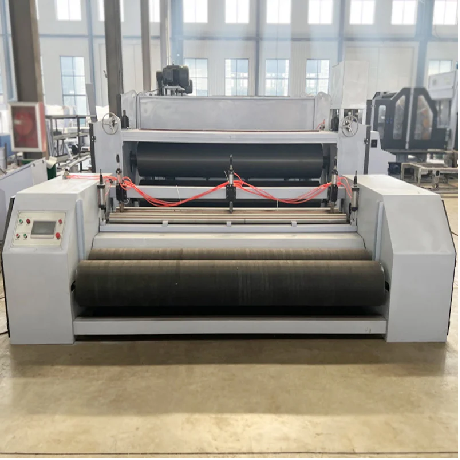
Located at the final stage of the nonwoven production line, the winding and cutting machine handles the finishing of the produced fabric. It trims the fabric to the specified width, cuts it to the required length, and winds it into finished rolls ready for packaging and shipment.
- Adjustable cutting width to meet product specifications.
- Programmable roll length for consistent finished goods.
- Smooth, tension-controlled winding for clean, professional rolls.
Why Choose Needle-Punched Nonwoven Geotextiles?
Among the various geotextile manufacturing methods available today, the needle-punching process stands out for its ability to produce fabrics with an optimal balance of strength, permeability, and cost efficiency. Unlike woven or spunbond alternatives, needle-punched nonwovens feature a three-dimensional, random fiber structure that delivers superior filtration performance and dimensional stability under load.
Needle-punched nonwoven geotextiles manufactured on this production line offer several distinct advantages that make them the material of choice for demanding engineering applications:
- Excellent permeability: The needle-punched structure allows water to pass through while retaining soil particles, making it ideal for filtration and drainage applications.
- Superior mechanical properties: High tensile strength, puncture resistance, and burst strength ensure long-term performance under load.
- Versatility: Suitable for a wide range of applications including road construction, railway subgrades, embankments, landfills, mining, and erosion control.
- Chemical resistance: Synthetic fiber composition provides resistance to chemicals, microorganisms, and environmental degradation.
- Cost-effective: Continuous, automated production keeps manufacturing costs competitive while maintaining consistent quality.
Geotextiles produced on a well-engineered production line deliver reliable, long-lasting performance in critical infrastructure — from water conservancy and airport construction to environmental protection and embankment reinforcement.
Applications of Geotextile Products
The nonwoven geotextiles produced by this manufacturing line are deployed across a broad spectrum of civil engineering and construction projects:
- Water Conservancy & Dams: Filtration, drainage, and seepage control in reservoirs, canals, and embankment structures.
- Airport Construction: Subgrade separation and reinforcement for runways, taxiways, and apron areas.
- Highway & Railway Engineering: Subgrade separation, filtration, and stress distribution beneath pavement and track layers.
- Environmental Protection: Landfill lining systems, leachate drainage, and slope erosion control.
- Mining & Tailings: Drainage, containment, and protective lining for tailings dams and heap leach pads.
Conclusion
A well-designed geotextile production line is the foundation of high-quality nonwoven geotextile manufacturing. Each machine — from the bale opener through to the winding and cutting machine — plays an indispensable role in converting raw synthetic fibers into durable, high-performance geotextile roll goods. With robust construction, advanced control systems, and industry-leading needle punching technology, this production line delivers the consistent quality, mechanical strength, and permeability that modern civil engineering projects demand.
Whether for water conservancy, airport construction, embankment reinforcement, or environmental protection, investing in a reliable, fully integrated geotextile production line ensures your manufacturing operation can meet the growing global demand for high-performance geosynthetic materials.