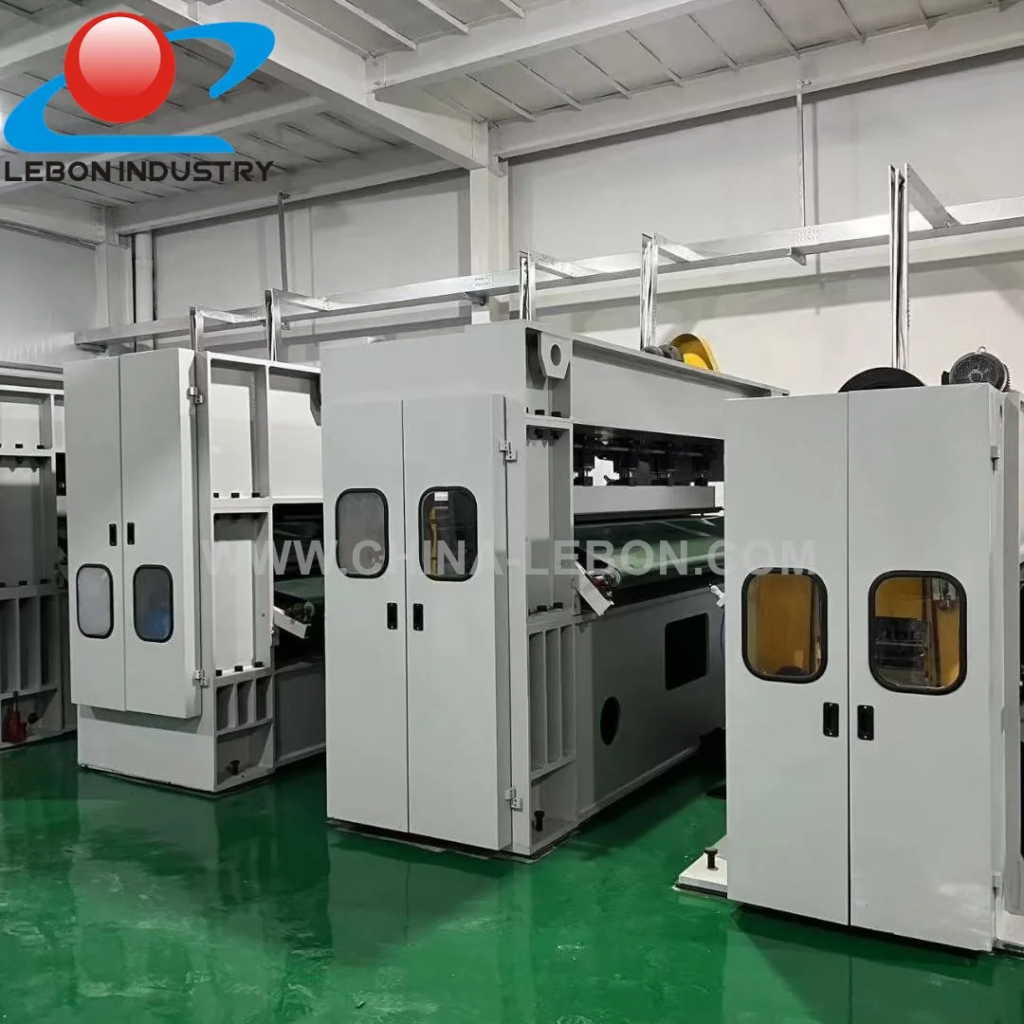
A nonwoven needle punching machine operates on the principle of mechanical fiber entanglement, eliminating the need for chemical binders or thermal bonding. By repeatedly driving barbed needles through a fiber web, the fibers are interlaced into a strong, cohesive nonwoven structure. This process is efficient, environmentally friendly, and highly adaptable to different product requirements.
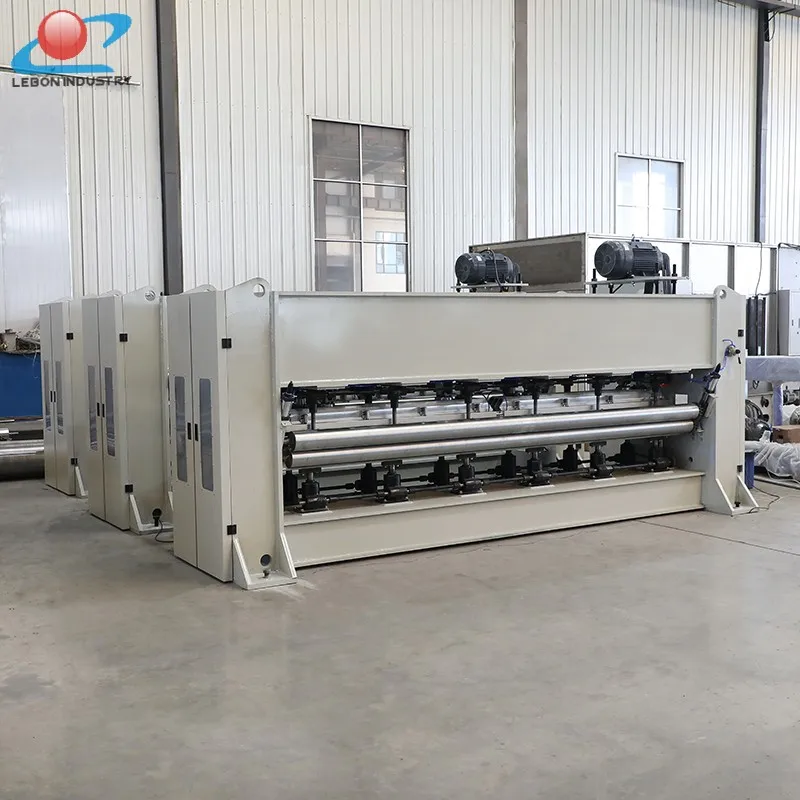
Working Principle of Needle Punching
- Needle Punching Operation
The prepared fiber web is continuously fed into the needle punching machine, where a needle board equipped with hundreds or thousands of barbed needles repeatedly penetrates and withdraws from the web at high speed.
Each needle features fine barbs along its shaft. As the needle enters the web, it catches surface fibers and pulls them vertically into lower layers. When the needle retracts, the fibers remain entangled, forming a mechanically bonded structure without adhesives. - Fiber Entanglement and Fabric Consolidation
With repeated punching, the fibers gradually form a three-dimensional interlocking network. Key parameters such as:
• Punch frequency (punches per minute, PPM)
• Needle penetration depth
directly influence fabric density, thickness, and tensile strength. Higher PPM results in tighter bonding and stronger fabrics, while adjustable penetration depth allows for fine-tuning product performance for various applications. - Post-Punching Finishing
After needle punching, the fabric can be further processed using additional equipment such as:
• Rib machines – for creating surface texture
• Jacquard machines – for patterned designs
• Velour machines – for raised or plush surfaces
These finishing options enable the production of customized nonwoven fabrics that meet diverse customer and market requirements.
Key Components of a Needle Punching Machine
- Needle Board
The needle board is a rigid plate that holds a large number of barbed needles. The needle arrangement (straight, staggered, or customized layouts) directly affects fabric texture, strength, and uniformity. Needles are typically made of high-carbon steel, ensuring durability, wear resistance, and a long service life. - Feeding System (FBC System)
The feeding system, usually composed of conveyors and rollers, transports the fiber web into the machine at a stable and controlled speed. Accurate feeding is essential to maintain uniform fabric thickness and prevent density variations across the product width. - Stroke Mechanism (Stroke Distance Control)
Driven by a crankshaft, camshaft, or modern servo motor system, this mechanism controls the vertical motion of the needle board. Advanced control systems allow precise adjustment of punch frequency and penetration depth, enhancing production consistency and flexibility. - Adjustment and Control System
Modern needle punching machines are equipped with mechanical or digital control interfaces that allow operators to adjust:
• Needle penetration depth
• Web feeding speed
• Needle density and punch frequency
This flexibility enables the production of nonwoven fabrics with weights ranging from 10 to 1,500 g/m², suitable for applications such as carpets, automotive interiors, filtration media, and industrial textiles.